CGPA Calculator Canada (4.33 Scale)
CGPA Calculator
Target CGPA
SGPA → CGPA
What Is a Canadian GPA Calculator?
A Canadian GPA Calculator is an online academic tool that calculates your Grade Point Average using the Canadian 4.33 grading scale. It combines your letter grades and course credit hours to produce a weighted GPA. Students can use the calculator to estimate semester GPA, cumulative GPA, and overall academic performance with greater accuracy.
If your university uses the Canadian 4.33 GPA scale, calculating your GPA should be simple and accurate. Simply enter your completed courses, select your letter grades, and add the correct credit values. The calculator automatically performs every weighted calculation and displays your GPA instantly.
What Is GPA in Canada?
GPA stands for Grade Point Average. It is one of the most common methods Canadian universities use to measure academic performance. Instead of averaging percentage marks directly, GPA converts your letter grades into numerical grade points. Each completed course contributes to your GPA according to both the grade earned and the course credit value.
Courses carrying more credit hours have a greater influence on your final GPA than courses with fewer credits. This weighted calculation provides a more accurate reflection of your overall academic performance.
Most universities calculate GPA at the end of every semester. Many institutions also calculate a Cumulative Grade Point Average (CGPA), which combines the results from every completed semester into one overall academic average. A semester GPA measures your performance during one academic term, while a CGPA measures your performance across your entire degree.
Why Is GPA Important?
Your GPA represents more than a collection of examination results. It reflects your academic consistency throughout your university studies. Many Canadian universities consider GPA when evaluating applications for honours programs, graduate degrees, research opportunities, and academic awards.
A strong GPA may improve your chances of receiving entrance scholarships, merit scholarships, exchange program opportunities, graduate school admission, internship placements, co-op opportunities, research assistant positions, and competitive graduate employment. Many employers also review GPA when hiring recent graduates, particularly for professional and technical careers.
Students often calculate their GPA before applying for scholarships, exchange programs, graduate schools, internships, or competitive job opportunities. Monitoring your GPA every semester helps you stay informed and make better academic decisions before graduation.
Understanding the Canadian 4.33 GPA Scale
Many Canadian universities use a 4.33 GPA scale to evaluate student performance. Under this system, each letter grade corresponds to a numerical grade point. Although the 4.33 grading scale is widely used across Canada, grading policies are not identical at every university. Institutions may assign different percentage ranges to the same letter grade. Always consult your university's official grading policy when interpreting GPA results.
| Letter Grade | GPA Value | Performance |
|---|---|---|
| A+ | 4.33 | Exceptional |
| A | 4.00 | Excellent |
| A− | 3.67 | Very Good |
| B+ | 3.33 | Good |
| B | 3.00 | Good |
| B− | 2.67 | Good |
| C+ | 2.33 | Satisfactory |
| C | 2.00 | Satisfactory |
| C− | 1.67 | Satisfactory |
| D | 1.00 | Minimum Pass |
| F | 0.00 | Fail |
Canadian GPA Formula
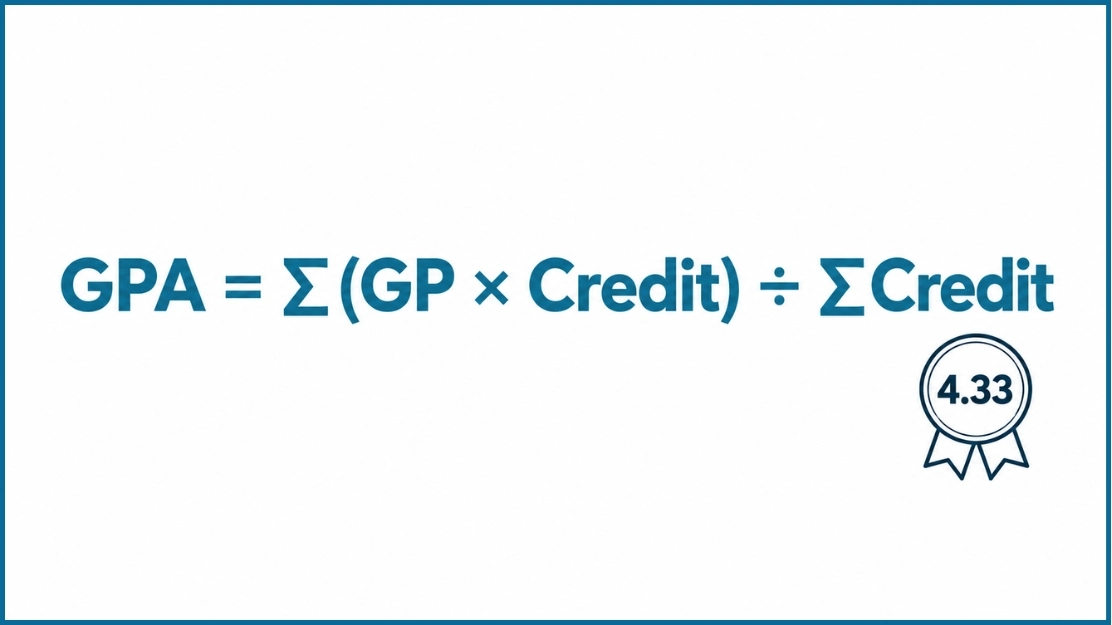
Most universities using the 4.33 grading system calculate GPA with the following formula:
Quality points for each course are calculated by multiplying the grade point by the course credit hours. For example, earning an A (4.00) in a 3-credit course gives 12.00 quality points. Courses carrying more credit hours contribute more quality points and have a greater influence on your final GPA.
Manual GPA Calculation Example
| Course | Credits | Grade | Grade Point | Quality Points |
|---|---|---|---|---|
| Canadian Literature | 3 | A | 4.00 | 12.00 |
| Statistics | 3 | A− | 3.67 | 11.01 |
| Microeconomics | 3 | B+ | 3.33 | 9.99 |
| Organizational Behaviour | 3 | B | 3.00 | 9.00 |
| Financial Accounting | 3 | A+ | 4.33 | 12.99 |
| Total | 15 | – | – | 54.99 |
GPA = 54.99 ÷ 15 = 3.67
How to Use This Canadian GPA Calculator
Enter Your Courses
Add every course you completed during the semester. Include all completed courses because each one contributes to your final GPA. Leaving out a course can produce an inaccurate result.
Enter the Course Credits
Enter the correct credit value for every course. Many Canadian universities assign three credit hours to standard undergraduate courses. Always use the official credit value shown on your transcript.
Select Your Letter Grade
Choose the letter grade you received for each course. The calculator automatically converts each letter grade into the correct grade point based on the Canadian 4.33 GPA scale.
Review Your Results
Your GPA updates instantly as you enter each course. Review the calculated GPA and compare it with your university records. Add multiple semesters to calculate your cumulative GPA.
GPA vs CGPA: What Is the Difference?
Many students use the terms GPA and CGPA interchangeably. Although they are closely related, they measure different parts of your academic performance. A GPA usually measures your performance during a single semester or study period. A CGPA combines the results from every completed semester into one overall academic average.
| Feature | GPA | CGPA |
|---|---|---|
| Full Meaning | Grade Point Average | Cumulative Grade Point Average |
| Covers | One semester | Entire academic program |
| Updates | Every semester | Throughout the degree |
| Purpose | Measures short-term performance | Measures overall academic performance |
| Common Use | Semester evaluation | Graduation, honours, scholarships, graduate admissions |
Universities Using This Scale
Canada has no single national GPA standard — each university sets its own scale. This calculator is built for the 4.33-point scale, which matches the official grading policy at:
Many other well-known Canadian universities use a different scale, so this 4.33 tool is not the right calculator for them:
Grading policies can vary by faculty and change over time, so always confirm the current scale in your own university's official academic calendar before relying on any GPA calculator.
Who Can Use This Calculator?
This calculator is suitable for students studying at Canadian universities that calculate GPA using the 4.33 grading scale. You can use this calculator if you are an undergraduate student, a graduate student, an international student, a transfer student, an exchange student, a scholarship applicant, or a student preparing for graduate school applications.
Academic advisers, parents, and educators may also use the calculator when helping students understand GPA calculations. The calculator is free to use and works on desktop computers, tablets, and smartphones. No registration or software download is required.
Why Use This Calculator?
Real-Time Calculation
Every grade and credit you enter instantly updates your GPA and progress bar: no Calculate button needed.
Target GPA Planner
Set a target GPA and see exactly what grades you need in remaining credits to reach your academic goal.
Multi-Semester Support
Add unlimited semesters and courses. Each semester shows its own SGPA, and the overall CGPA reflects your complete academic record.
Downloadable Report
Download a professional academic report with all semesters, courses, and GPA breakdown: ideal for scholarship and graduate applications.
Built for the 4.33 Scale
Pre-configured for the exact grading scale used by UBC and other institutions that award 4.33 for an A+.
Mobile Friendly
Fully responsive and optimised for all screen sizes. Use it on your phone, tablet, or desktop with no app required.
Common GPA Calculation Mistakes
Many students calculate GPA incorrectly because they overlook small details. Avoiding these mistakes improves the accuracy of your results.
Entering incorrect course credits. Always verify the official credit value before calculating your GPA. Using incorrect credits changes the weighted calculation and produces an inaccurate GPA.
Selecting the wrong letter grade. Choose the exact letter grade shown on your official transcript. Even one incorrect grade can significantly change your final GPA.
Mixing the 4.0 and 4.33 GPA scales. Many online calculators use a standard 4.0 grading system. If your university follows the Canadian 4.33 scale, using the wrong calculator will produce incorrect results.
Ignoring failed courses. Failed courses usually receive 0.00 grade points. Because they still carry credit hours in many university policies, they can lower your GPA significantly.
Forgetting repeated courses. Universities often apply different policies for repeated courses. Some replace the previous grade, while others include both attempts when calculating GPA. Always review your institution's academic regulations.
Tips to Improve Your GPA
Attend Every Class
Regular attendance helps you understand course concepts before assignments and examinations. Missing lectures often creates learning gaps that become harder to close later.
Focus on High-Credit Courses
Courses with more credit hours have a greater impact on your GPA. Strong performance in these courses can improve your overall academic average more effectively.
Complete Assignments on Time
Assignments, presentations, and projects often contribute a large portion of your final grade. Submitting quality work on time helps maximize available marks.
Review Instructor Feedback
Feedback explains where you performed well and where you can improve. Applying that feedback to future assignments strengthens your academic performance.
Build a Weekly Study Routine
Studying consistently throughout the semester reduces stress before examinations and improves knowledge retention and long-term understanding.
Seek Academic Support Early
Speak with professors, teaching assistants, or academic advisers whenever you need help. Seeking support early often prevents small challenges from becoming larger problems.
GPA Benchmarks at Canadian Universities
These are general patterns, not official policy. Always confirm current thresholds with your university's academic calendar or registrar's office.
Frequently Asked Questions
GPA stands for Grade Point Average. Canadian universities convert letter grades into numerical grade points, then calculate a weighted average based on course credit hours. Most Canadian universities use a 4.33 grading scale where A+ equals 4.33 points.
Yes. At universities using the 4.33 grading scale, 4.33 is the highest possible GPA and corresponds to an A+ grade. This is one of the key differences from the US 4.0 scale, which caps all A grades at 4.00.
A GPA of 3.70 or above is generally considered excellent at many Canadian universities. A GPA above 3.00 is regarded as strong academic performance for most programs. Because grading standards differ between institutions, always interpret your GPA according to your university's academic policies.
GPA = Total Quality Points ÷ Total Credit Hours. Quality points are calculated by multiplying the grade point by the course credit value. For example, earning an A (4.00) in a 3-credit course gives 12.00 quality points.
A GPA usually measures performance during one semester. A CGPA (Cumulative Grade Point Average) combines the results from every completed semester throughout your degree program into one overall academic average.
No. Many universities use the 4.33 grading system, while others follow slightly different GPA scales or institutional grading methods. Always verify your university's grading policy before calculating your GPA.
Yes. International students enrolled at Canadian universities using the 4.33 grading scale can use this calculator to estimate their GPA. The calculator is free and requires no registration.
Yes. Failed courses usually receive 0.00 grade points, which can lower your overall GPA depending on your university's academic policy. Always include failed courses in your calculation for an accurate result.
There is no universal conversion formula. Every Canadian university defines its own grading policies and percentage ranges for letter grades. Always use your institution's official conversion guidance or contact the registrar's office when an official percentage equivalent is required.
Most Canadian graduate programs require a minimum GPA of 3.0 on the 4.33 scale (B average). Competitive programs in medicine, law, engineering, and business at top universities typically expect a GPA of 3.5 or above.
The extra 0.33 exists so an A+ can be distinguished from a straight A. On the US 4.0 scale, A+ and A both cap at 4.00, but many Canadian schools reward an A+ with 4.33 to reflect the higher grade separately.
Provincial aid programs like OSAP generally require you to maintain satisfactory academic standing (usually a passing course load) rather than a specific GPA number, but falling into academic probation can affect eligibility. Check your province's student aid office for exact rules.
CGPA Guides & Resources
What Is CGPA?
Understand what CGPA means, how it differs from GPA, and why universities worldwide use it to measure academic performance.
Read guide → →CGPA Formula Explained
Break down the weighted average formula with step-by-step examples using quality points and credit hours.
Read guide → →What Is a Good CGPA?
Find out what your CGPA means for jobs, graduate school, and scholarships, with realistic benchmarks by field.
Read guide →