NSU CGPA Calculator (North American 4.0 Scale)
CGPA Calculator
Target CGPA
SGPA → CGPA
What Is the North American 4.0 GPA Scale?
📖 Direct Answer: The North American 4.0 GPA scale converts each letter grade into a fixed grade-point value: A = 4.0 down to F = 0.0: then weights it by credit hours to produce your GPA. It's the standard system used across the US, Canada, and most private universities in Bangladesh, including NSU, BRAC, IUB, UIU, EWU, and AIUB.
If you study at North South University (NSU), BRAC University, IUB, UIU, EWU, or AIUB, this is the exact grading scale your department already uses in Bangladesh. It's called the "North American" scale because it originated at US and Canadian universities, but it has become the standard grading policy at most top private universities in Bangladesh as well. If you instead study at a public university or under National University (NU), your CGPA follows a different, more lenient UGC scale: use the CGPA Calculator instead so your result matches your actual transcript.
Beyond Bangladesh, the North American 4.0 GPA scale is one of the most widely used academic grading systems in the world, forming the standard method for measuring academic performance at colleges and universities across the United States and Canada. Instead of calculating results directly from percentages, this system converts letter grades into numerical grade points, which are then weighted by credit hours to produce a student's Grade Point Average (GPA).
Under the standard 4.0 scale, each letter grade corresponds to a specific grade-point value. An A typically equals 4.0 grade points, an A− equals 3.7, a B+ equals 3.3, and lower grades receive progressively lower values. Once grade points are assigned, each course grade is multiplied by its credit hours to calculate quality points, which are then used to work out the cumulative GPA.
Unlike grading systems that assign grade points directly from fixed percentage ranges, the North American GPA system follows a credit-weighted approach: courses carrying more credit hours have a greater impact on the final GPA than courses with fewer credits. For NSU and BRAC students in particular, this means a 3-credit core course will move your CGPA more than a 1-credit lab, so it's worth tracking which courses carry the most weight each semester.
Standard North American Grade Scale
| Letter Grade | Grade Points |
|---|---|
| A | 4.0 |
| A− | 3.7 |
| B+ | 3.3 |
| B | 3.0 |
| B− | 2.7 |
| C+ | 2.3 |
| C | 2.0 |
| C− | 1.7 |
| D+ | 1.3 |
| D | 1.0 |
| F | 0.0 |
This grading structure is commonly used for calculating both semester GPA and cumulative GPA, helping students monitor their academic progress throughout a degree program.
How the North American GPA System Works
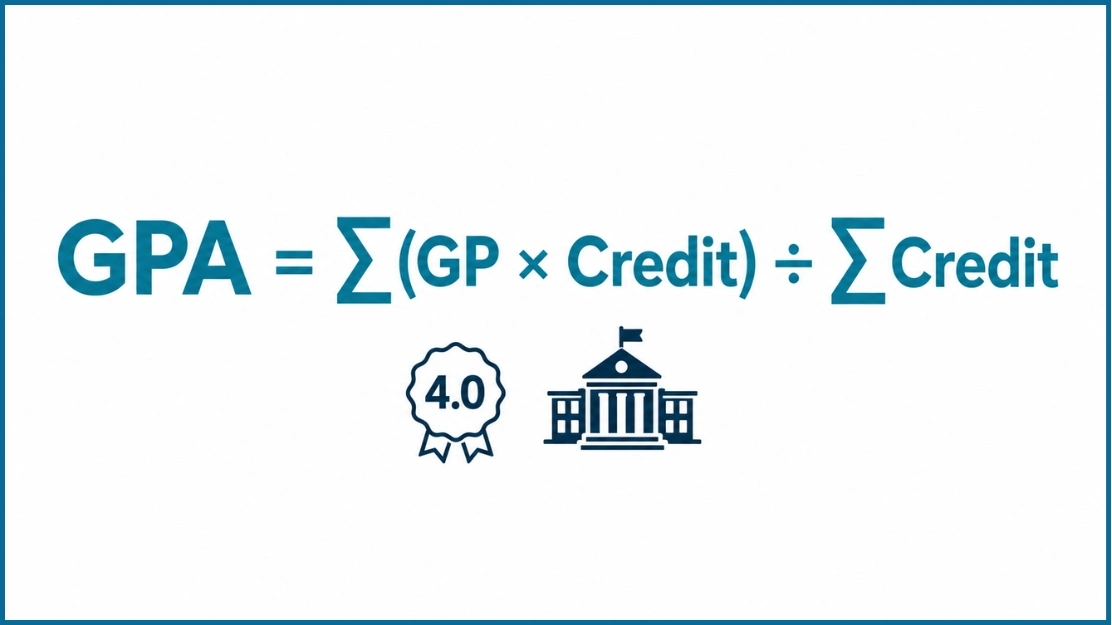
The calculation process is based on three key components:
- Letter Grades – The final grades earned in each course (A, A−, B+, B, etc.)
- Grade Points – The numerical value assigned to each letter grade
- Credit Hours – The academic weight of a course, which determines how much it influences the final GPA
For example, earning an A (4.0) in a 4-credit course contributes more to your GPA than earning the same grade in a 2-credit course because the course carries greater academic weight.
GPA Formula
Expanded:
GPA Calculation Example
| Course | Grade | Credits |
|---|---|---|
| MAT116 (Calculus) | A | 3 |
| PHY107 (Physics I) | B+ | 4 |
| ENG102 (English Composition) | A− | 3 |
Step 1: Convert each grade to quality points
| Course | Grade Point | Credits | Quality Points |
|---|---|---|---|
| MAT116 | 4.0 | 3 | 12.0 |
| PHY107 | 3.3 | 4 | 13.2 |
| ENG102 | 3.7 | 3 | 11.1 |
| Total | 10 | 36.3 | |
Step 2: Divide total quality points by total credit hours
With an A in Math, a B+ in Physics, and an A− in English, the resulting GPA is 3.63 on the North American 4.0 scale.
Who Uses the North American 4.0 Scale?
This grading system is commonly used by:
- Undergraduate students
- Graduate students
- Community college students
- International students studying in North America
- Transfer students evaluating academic equivalency
- Scholarship and admissions applicants
Many universities, colleges, and academic institutions use a variation of the 4.0 GPA scale when evaluating academic standing, graduation eligibility, honors distinctions, scholarship requirements, and admission applications.
North American GPA vs Traditional CGPA Systems
A common source of confusion is the difference between a North American GPA and a traditional CGPA system used in many Asian, Middle Eastern, and international institutions.
In many CGPA systems, grade points are assigned directly from predefined grading scales, such as A+ = 4.0, A = 3.75, B+ = 3.5, and so on. The North American model, however, is based on letter grades and credit-weighted calculations, where GPA is determined by the total quality points earned across all completed courses.
| Feature | North American GPA System | Traditional CGPA System |
|---|---|---|
| Grade Input | Letter grades (A, A−, B+, B, etc.) | Direct grade points or percentages |
| A Grade Value | A = 4.0 | Often varies by institution |
| Credit Hours | Usually required for calculation | May or may not be required |
| Calculation Method | Quality points divided by total credit hours | Average grade points across courses |
| Common Scale | 4.0 GPA Scale | 4.0, 5.0, 10.0, or custom scales |
| Most Common Regions | United States and Canada | Asia, Middle East, Africa |
| Input Format | Letter grades and credits | Grade points, marks, or percentages |
Because of these differences, students should always use a calculator that matches their institution's grading policy. If your school follows the North American grading system where A equals 4.0 grade points, this calculator provides the most accurate GPA calculation based on letter grades, credit hours, and cumulative academic performance.
Universities Using This Scale
The North American 4.0 GPA scale is the standard grading framework across most universities and colleges in the United States and Canada, where letter grades such as A, A−, B+, B, and C are converted into grade points and weighted according to credit hours to calculate a student's cumulative GPA. This grading model is used by many globally recognized institutions, including the following.
While individual grading policies may vary slightly between institutions, the underlying 4.0 GPA methodology remains largely consistent. In Bangladesh, the North American-style 4.0 grading system is also widely adopted by leading private universities, including North South University (NSU), BRAC University, Independent University Bangladesh (IUB), United International University (UIU), East West University (EWU), and American International University-Bangladesh (AIUB), among others.
As a result, this calculator is particularly useful for:
- NSU, BRAC University, IUB, UIU, EWU, and AIUB students
- Students studying in U.S. and Canadian universities
- International students applying to North American institutions
- Transfer and exchange program applicants
- Scholarship and graduate school applicants
If your institution calculates grades using letter grades such as A, A−, B+, B, C+, and assigns grade points on a 4.0 scale, this calculator is designed for your academic system.
Using This for NSU or BRAC University?
If you study at North South University (NSU), you're in the right place. NSU's official grading policy follows the North American 4.0 scale: the exact system this calculator uses, with letter grades from A to F and plus/minus modifiers worth 0.3 grade points each.
| Numerical Score | Letter Grade | Grade Point |
|---|---|---|
| 93 and above | A | 4.0 |
| 90 – 92 | A− | 3.7 |
| 87 – 89 | B+ | 3.3 |
| 83 – 86 | B | 3.0 |
| 80 – 82 | B− | 2.7 |
| 77 – 79 | C+ | 2.3 |
| 73 – 76 | C | 2.0 |
| 70 – 72 | C− | 1.7 |
| 67 – 69 | D+ | 1.3 |
| 60 – 66 | D | 1.0 |
| Below 60 | F | 0.0 |
To use this calculator for your NSU CGPA, simply enter each course's letter grade and credit hours per semester: the tool automatically applies the same A=4.0, A−=3.7, B+=3.3 grading logic NSU uses on your official transcript. NSU requires a minimum CGPA of 2.00 to qualify for a degree, and final CGPA also determines Latin honors at graduation (Summa Cum Laude, Magna Cum Laude, and Cum Laude).
Note: individual instructors at NSU have some discretion over exact grade cut-off points, so always confirm your final result against your official RDS transcript or the NSU Grading Policy page.
BRAC University, IUB, UIU, EWU, and AIUB students can use this exact same calculator. These universities apply the same North American-style structure: A = 4.00 down to F = 0.00 with 0.3-point plus/minus modifiers, so the grade points and formula on this page match their official transcripts as well. As with NSU, always cross-check your final CGPA against your university's official grading policy or Connect/UCAM/UMS portal, since some institutions round differently at the C+/C boundary.
Understanding Common GPA Ranges
A GPA is more than just a number: it is one of the most widely used indicators of academic performance in North American colleges and universities. Your GPA can influence scholarship opportunities, academic standing, internship eligibility, transfer applications, graduate school admissions, and even certain job opportunities after graduation.
While GPA expectations vary between institutions and programs, the following ranges provide a general benchmark for interpreting academic performance on the North American 4.0 scale.
| GPA Range | Academic Performance |
|---|---|
| 3.8 – 4.0 | Excellent |
| 3.5 – 3.79 | Very Good |
| 3.0 – 3.49 | Good |
| 2.0 – 2.99 | Satisfactory / Average |
| Below 2.0 | Academic Risk |
Common GPA Calculation Mistakes to Avoid
Calculating GPA may seem straightforward, but small mistakes can lead to inaccurate results and a misunderstanding of your actual academic standing. Understanding these common errors can help ensure that your GPA accurately reflects your academic performance.
Ignoring Credit Hours
One of the most common mistakes is treating every course equally, regardless of credit hours. In the North American system, GPA is a weighted average: courses with more credit hours have a greater impact on your final GPA. Always multiply the grade points earned by the credit hours before calculating the overall average, or the result may not match your official transcript.
Using Percentages Instead of Letter Grades
Many students try to calculate GPA by directly converting percentages into grade points. This often leads to inaccurate results because the North American system is based primarily on letter grades. An 85% may be an A at one institution and a B+ at another, so always determine the official letter grade first.
Confusing the 4.0 and 4.3 Scales
Not all universities use the same GPA scale. While most US and Canadian schools use a standard 4.0 scale, some use a 4.3 scale where an A+ receives 4.3 grade points instead of 4.0. Using the wrong scale can significantly inflate or underestimate your GPA, so always verify your institution's grading policy first.
Treating A+ Grades Incorrectly
Many students assume an A+ is always worth more than an A. In many North American institutions both are valued at 4.0, while others award 4.3 for an A+. Always check your school's grading guidelines before assuming extra credit for a plus grade.
Mixing International and North American Grading Systems
International students sometimes combine grades from different educational systems within a single GPA calculation. A grade point value valid in one country may not carry the same meaning in another, for example, a 10-point CGPA scale cannot be directly combined with a North American 4.0 GPA without proper conversion.
Relying on Unofficial Conversion Charts
Different universities apply unique grade boundaries and credit-weighting rules, so two students with identical percentage scores may receive different GPA values depending on their institution. Whenever possible, refer to official university grading policies rather than random online charts.
Entering Incorrect or Missing Courses
Even small data-entry errors can affect GPA calculations. Students sometimes forget repeated courses, electives, or transferred credits. Before calculating your GPA, review your transcript carefully and confirm that all courses, grades, and credit hours have been entered correctly.
Why Use This Calculator?
Real-Time Calculation
Every grade and credit you enter instantly updates your GPA and progress bar: no "Calculate" button needed.
Target GPA Planner
Set a target GPA and see exactly what grades you need in remaining credits to hit your goal.
Multi-Semester Support
Add unlimited semesters and courses. Each semester shows its own SGPA, and the overall CGPA reflects your complete academic record.
Downloadable Report
Download a professional academic report with all semesters, courses, and GPA breakdown: ideal for applications.
Built for US & Canada
Pre-configured for the exact grading scale used by MIT, Harvard University, and similar institutions.
Mobile Friendly
Fully responsive and optimised for all screen sizes. Use it on your phone, tablet, or desktop: no app needed.
CGPA Rules at North South University
These reflect NSU's published academic policies. Other North American-scale universities (BRAC, IUB, UIU, EWU, AIUB) may set different thresholds — always confirm with your own registrar's office.
Frequently Asked Questions
A 4.0 GPA scale is the most widely used academic grading system in the United States and many Canadian universities. Under this system, letter grades are converted into grade points, with A = 4.0, A− = 3.7, B+ = 3.3, and so on. Your GPA is calculated by multiplying each course's grade points by its credit hours, then dividing the total quality points by the total number of credit hours.
Yes, in the standard North American 4.0 grading system, an A grade is typically worth 4.0 grade points. However, grading policies can vary by institution: some schools award 4.0 for both A and A+, while others use a 4.3 scale. Always check your university's grading policy if you're unsure.
The value of an A+ depends on your institution's grading system. Many universities in the United States treat A+ and A as 4.0 GPA points, while some colleges and universities use a 4.3 scale and award 4.3 points for an A+. This calculator uses the standard North American 4.0 scale unless otherwise specified.
Multiply the grade points earned in each course by the course's credit hours, add the quality points together, then divide by the total number of credit hours completed. GPA = Total Quality Points ÷ Total Credit Hours. This ensures courses with more credit hours have a greater impact on your final GPA.
A "good" GPA depends on your academic goals and institution, but a GPA of 3.0 or higher is generally considered a strong academic achievement. GPAs between 3.5 and 4.0 are often viewed as excellent and competitive for scholarships, admissions, and graduate programs, which often prefer GPAs above 3.5.
No. GPA usually represents your performance during a single semester, term, or academic period, while CGPA represents your overall academic performance across all completed semesters or years of study. Many universities use CGPA as the primary measure of long-term academic performance.
Many Canadian universities use a GPA system similar to the North American 4.0 scale, but grading policies vary by institution. Some follow a standard 4.0 scale, while others use a 4.3 scale or institution-specific grading methods. Always consult your university's official grading policy when calculating GPA.
An A− generally carries a value of 3.7 grade points on a standard 4.0 GPA scale. While still an excellent grade, it contributes slightly fewer grade points than a full A, which is worth 4.0. The exact impact on your overall GPA depends on the credit hours assigned to that course.
Yes, percentages can often be converted to GPA, but there is no universal conversion formula: different universities, countries, and credential evaluation services use different methods. To get the most accurate result, use the conversion method specified by your own institution.
A weighted GPA assigns additional value to more challenging courses, such as Advanced Placement (AP), Honors, or International Baccalaureate (IB) classes. For example, an A in a standard course may be worth 4.0 points, while an A in an advanced course may be worth 4.5 or 5.0. Weighted GPAs are commonly used by high schools to recognize students taking more rigorous coursework.
An unweighted GPA uses the standard grading scale without considering course difficulty: every course is treated equally regardless of whether it is standard, honors, or advanced. On a traditional 4.0 scale, the highest possible unweighted GPA is 4.0.
Yes. North South University's official grading policy follows the North American 4.0 scale, with A = 4.0, A− = 3.7, B+ = 3.3, and plus/minus modifiers worth 0.3 grade points. This calculator uses the same scale, so NSU students can use it to calculate their semester GPA and cumulative CGPA.
Yes. BRAC University follows the same North American-style 4.0 grading scale as NSU, with A = 4.00, A− = 3.70, and B+ = 3.30. This calculator applies that exact scale, so BRAC students can calculate accurate semester GPA and cumulative CGPA here.
NSU, BRAC University, IUB, UIU, EWU, and AIUB all follow this North American-style 4.0 grading scale. If you study at a public university or under National University (NU) instead, use our CGPA Calculator, which follows the common UGC-style 4.0 grading scale.
The North American GPA system is widely used by colleges and universities throughout the United States and Canada, including institutions such as Harvard University, Stanford University, MIT, the University of Toronto, and the University of British Columbia. In Bangladesh, this same scale is followed by NSU, BRAC University, IUB, UIU, EWU, and AIUB. Grading scales can still vary between institutions, so always refer to your school's official policy for the most accurate calculation.
You'll be placed on academic probation and given up to three semesters to bring your CGPA back to 2.00 or above. If you don't reach it within that window, you may be dismissed ("excluded") from the university, per NSU's published academic policy.
When you retake a course, the new grade completely replaces the old one in your CGPA calculation — the previous attempt still appears on your transcript marked "R" but no longer affects your CGPA.
CGPA Guides & Resources
What Is CGPA?
Understand what CGPA means, how it differs from GPA, and why universities worldwide use it to measure academic performance.
Read guide → →CGPA Formula Explained
Break down the weighted average formula with step-by-step examples using quality points and credit hours.
Read guide → →What Is a Good CGPA?
Find out what your CGPA means for jobs, graduate school, and scholarships, with realistic benchmarks by field.
Read guide →